


Fighting for a place to play: Dragones de Lavapiés take football to Madrid's streets
Updated: 10 hours ago

Photos in this article: David Calle
For more than a decade, Dragones de Lavapiés has been creating opportunities for children to play football in one of Madrid's most diverse neighbourhoods. But the struggle to secure safe, accessible spaces has never gone away. Now, with their pitches unavailable, the community has taken its fight to the streets.
On Friday, 9 October, Ronda de Valencia, a busy street in central Madrid, became a football pitch.
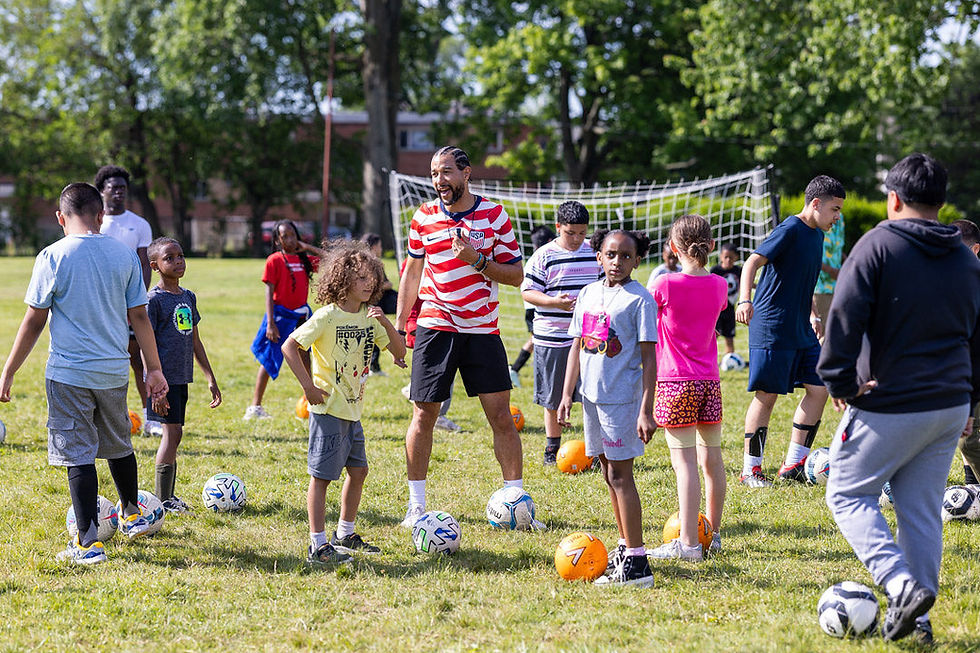
Around 150 children, families and neighbours gathered with footballs, makeshift goals and a clear message: every child deserves a safe place to play.
Organised by Dragones de Lavapiés, the demonstration temporarily interrupted traffic to draw attention to the shortage of accessible sports facilities in the neighbourhood.
But this was more than a protest against delayed renovation works. It was the latest chapter in a struggle that has accompanied the club for much of its existence.

A football community built from the ground up
For Dragones de Lavapiés, finding somewhere to play has never been straightforward.
In 2016, the club secured permission to use an abandoned plot on Calle Embajadores 18. The ground was in poor condition, with inadequate lighting and little infrastructure. But rather than wait for a ready-made football pitch, the community got to work.
Children, families and volunteers helped transform the space into somewhere they could play.
Three years later, with support from Madrid City Council and the Atlético de Madrid Foundation, the plot became an artificial-turf football pitch.
It was a significant achievement for a club that had grown around a simple belief: football should be accessible to everyone, regardless of their background or circumstances.
Yet maintaining that space proved to be another challenge.
By 2024, the pitch had deteriorated considerably, but Dragones continued to seek solutions. The club secured a donation of a new playing surface from a generous company specializing in sports infrastructure, once again transforming the space for the betterment of the neighborhood. While further municipal renovations were still pending, the new surface left the pitch in better condition than ever before.
In September 2025, those works finally began. But they were subsequently halted following the discovery of underground structures, leaving the pitch unavailable.
At the same time, planned works at another neighbourhood facility, Casino de la Reina, created further uncertainty for the club's teams.
For a community that had spent years working to secure somewhere to play, the situation was becoming increasingly difficult as these were the only two fields in the neighbourhood.
Today, Dragones de Lavapiés brings together around 600 players representing nearly 60 nationalities.
Through football, the organisation creates opportunities for children, women, refugees and people who often face barriers to participation. Its work extends beyond the pitch, promoting inclusion, equality and a sense of belonging in a neighbourhood shaped by extraordinary cultural diversity.
But these opportunities depend on access to physical spaces.
With local pitches unavailable, all teams have been forced to travel outside the neighbourhood to continue training.
For families balancing work, childcare, transport costs and other responsibilities, that additional journey can make participation difficult or even impossible.
And when a child can no longer attend training, the loss extends far beyond football.
It means missing time with friends, trusted relationships with coaches, opportunities to build confidence and a place where they feel part of something.
For Dragones, the lack of accessible infrastructure is therefore not simply a logistical challenge. It threatens the very opportunities the organisation has spent years building.

Taking the game to the streets
On 9 October, children and families decided to make that reality visible.
They brought their footballs onto Ronda de Valencia, transforming part of the road into a temporary playing space.
The demonstration was a call for the completion of renovation works, the reopening of local facilities and access to suitable alternatives while the pitches remain unavailable.
It also carried a wider message about the place of community sport in our cities.
For more than a decade, Dragones de Lavapiés has shown what can happen when people come together around football. Children from different countries and cultures have found common ground. Families have built connections. A neighbourhood has created something that belongs to everyone.
But the future of those opportunities cannot depend indefinitely on communities finding temporary solutions to a persistent infrastructure problem.

Every child deserves a place to play
Across the world, community football organisations are creating opportunities for young people, strengthening social connections and building more inclusive communities.
Their impact is often celebrated through the stories of the children and families whose lives they touch.
But behind those stories lies something fundamental: the need for safe, accessible and reliable places to play.
A football pitch is more than a piece of infrastructure. It is where relationships develop, confidence grows and communities come together.
The story of Dragones de Lavapiés is a reminder that these spaces cannot be taken for granted.
After years of creating and defending their own opportunities to play, the children of Lavapiés are asking for something simple: a place where they can keep playing, together.

Comments