


Why Football Festivals Matter
What 570+ grassroots football festivals tell us about football communities across the US
When people look back on this FIFA World Cup, they'll remember the goals, the upsets and the champions.
But across the United States, another story unfolded alongside the tournament.
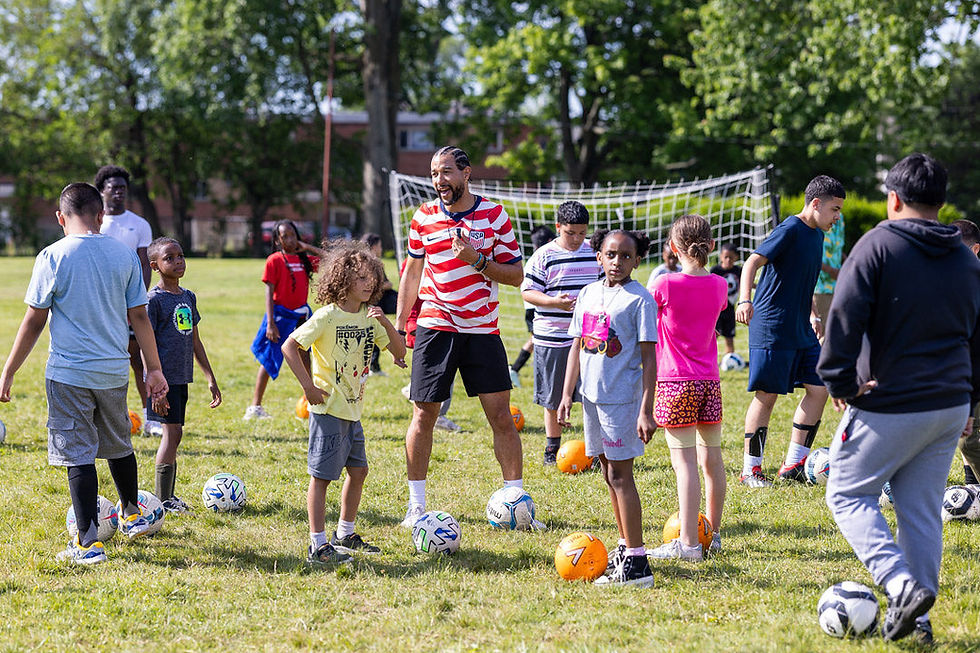
Over the past few months, more than 570 Soccer Forward Fests emerged across all 50 states and Washington, D.C. They took place in neighbourhood parks, schools, community centres and local pitches. Some were youth tournaments. Others were coaching clinics, block parties, cultural celebrations or community watch events. Every Fest looked different because every community decided for itself what a World Cup celebration should look like.
Taken individually, these were local events. Together, they became something much bigger: a nationwide expression of what football can mean beyond the professional game.
At a time when many conversations about the United States focus on what separates communities, these festivals quietly highlighted something else. Across neighbourhoods with different cultures, histories and identities, people kept arriving at remarkably similar ideas about what football could offer: a reason to gather, to welcome others and to create a sense of belonging. The game became common ground.
Community legacy across all 50 States

Football festivals have always been about participation rather than spectatorship. They create opportunities for people to play, connect, celebrate and belong. For nearly twenty years, Common Goal and its community have used festivals to connect football's biggest moments with the communities at the heart of the game—from Germany in 2006 to South Africa in 2010, Brazil in 2014, Russia in 2018, France in 2019 and Australia in 2023.
This year, however, that idea reached a new scale.
Hundreds of communities created their own World Cup experiences. The result wasn't a single legacy project, but hundreds of locally owned ones, each reflecting the priorities, identities and ambitions of the people who organised them.
What is perhaps most striking is how consistent those priorities turned out to be.
Although the festivals were organised independently, organisations repeatedly described the same motivations. Their focus was rarely competition or performance. Instead, they spoke about community connection, youth participation, inclusion, family engagement and creating spaces where people could come together through football.
As BAMBA Sports in the Bronx explained:
"Growing up in the diaspora, we saw how soccer naturally brings communities together across culture, language, and background. Soccer is the bridge — community is the goal."
Unique Ballers FC in Brooklyn expressed a similar sentiment:
"For us, the score that matters is measured in community, not goals. We focus on bringing girls together from every background and socioeconomic status to celebrate the beautiful game."
These weren't isolated examples. When we analysed the themes emerging across hundreds of registered Fests, the same ideas appeared again and again: community and connection, youth engagement, inclusion and diversity, girls' empowerment, personal growth and cultural celebration. Despite taking place thousands of miles apart—in cities and small towns, across different regions and communities—organisations consistently described football as a way of strengthening relationships rather than reinforcing differences. That consistency may be one of the most remarkable findings of all.
"What Soccer Forward Fests made visible was a side of football that often goes unseen. Beyond the professional game, hundreds of communities were using football to bring people together, create opportunities for young people and strengthen neighborhoods. Taken together, those celebrations remind us that football's story is far bigger than the professional game," said Mary Connor, CEO, Common Goal.

Young people were at the heart of almost every celebration. More than 83% of all registered Fests were designed specifically around youth participation, with an estimated 85,000 people expected to take part before the tournament concludes. Schools became major organisers, while community organisations used football to create opportunities for learning, leadership and friendship beyond the pitch.
Many also saw the World Cup as a chance to widen who feels the game belongs to. Across the country, festivals created spaces for girls to play and lead, welcomed refugee and immigrant communities, supported neurodivergent young people and celebrated the cultural diversity that has always shaped football.
Unique Ballers FC in Brooklyn captured that ambition:
"By designing an event specifically for girls, we are sending a clear message that their growth, their joy, and their place in this game are our priority."
Perhaps the most significant outcome, however, was where these festivals happened.
More than half took place outside FIFA World Cup Host Cities. That meant communities unlikely ever to host a World Cup match could still become part of the tournament's story. Rather than concentrating legacy in a handful of venues, Soccer Forward Fests helped distribute the spirit of the World Cup across neighbourhoods throughout the country.
That may ultimately be one of the programme's greatest achievements.
For decades, discussions about tournament legacy have often focused on infrastructure, stadiums or economic impact. Those investments matter, but this year's festivals suggest another way of thinking about legacy altogether. Legacy can also be measured in the spaces where people who might never otherwise meet spend an afternoon together. In the young people who discover football for the first time. In families sharing the game across generations. In the girls who feel the game welcomes them. In neighbours who leave knowing each other a little better than when they arrived. These are quieter outcomes than a new stadium, but they may prove far more enduring.
Soccer Forward Fests was created to surface and celebrate that kind of legacy. Not by telling communities what their legacy should be, but by giving them the opportunity to define it themselves and recognising the work that often happens far from the spotlight.
More than 570 festivals cannot tell the story of an entire country. But together they offer a remarkable snapshot of what communities choose when football is placed in their hands. Again and again, they chose connection over competition, participation over spectatorship and belonging over exclusion.
If these festivals have shown us anything, it is that football's biggest moments do not only happen inside stadiums.
They happen wherever people come together around the game.
And wherever they do, football reminds us that what connects us will always be more powerful than what divides us.
Perhaps that is the score that future World Cups should care most about.

Comments